CHAPTER-6
OF (15)

26th of
July 2012, our today’s route is around Boulevard road of Srinagar, because
today we are sightseeing only few of the Mughal Gardens.

Today
the first thing after bathing, we did perform Pooja at Zeshta Devi
temple and prayed for our safe motor biking, further journey. Then after
the breakfast at Dal Gate, Bhusahan Parimoo took us ( Kiran Kinni, Ganesh,
Krishna Hebbar, Abhimanyu and me) to “Tourist Reception Center" building, where the director of Tourism, (Kashmir Division) Mr. Talat
Parvez Rohella's, office is. Since Bushan Parimoo knows Mr. Talat Parvez
Rohella, it was just a curtsy call. Though Mr.
Talat Parvez Rohella, was already busy with other of his prior planned
meetings, still it was great of him to spare few minutes just to meet us. Because of his aggressive dynamic efforts the Kashmir tourism had increased tremendously. He is
very courteous and humble gentle man and he
assured us of any help we needed and wished us enjoyable safe journey too.
From
the “Tourist Reception Center building”, we rode our motor bikes all
along the Boulevard road. It was more than a dream come true feelings of
ridding our majestic "Royal Enfield" motor bikes, on a wide flawless
road, which on one side has endless rows of the most colourful,
beautiful most attractive and decorated House Boats and Shikaras, of the Dal Lake. On the other side are the ranges of Peer Panchal snow clad,
“Zabarwan-mountains”. Then from the front cold fresh winds full of
nature’s fragrances, gently brushed against our faces with its soothing feelings. At our back side, we left behind us the most scenic beauty
of beautiful Kashmir. However hard I may try, I have neither the appropriate words, nor the
proper vocabulary to express those blissful and delightful ever
lasting feelings. To thoroughly feel these blissful feelings, one has to
be present there on the Boulevard, to feel what I am trying to convey
you.
A Brief Introduction of Mughal Gardens of Kashmir
Impressed
with the abundant natural beauty, Mughals loved this place so much that they
have contributed many beautiful gardens to the city of Srinagar. Well-planned
and vast, these gardens are home to a variety of flora and delightful water
systems. They retain something of the elaborately planned Persian gardens and
are mostly terraced to suit the environs of the mountainous slopes.
Gar
Firdaus rōy-e zamin ast,
hamin ast--o
hamin ast--o hamin ast.
This is a couplet by the Persian poet
“Amir Khusrau”, which is inscribed in Persian on
the black pavilion built during the early part of Jahangir's reign (1569–1627), in the top terrace of the Shalimar Bagh. .
Translated to English, it means.
‘If there is a paradise on earth, it is here, it is here, it is here.”
|
It is also mentioned that when Jahangir was asked on his death bed about his cherished desire, he is credited
to have said:
Kashmir, the rest is worthless.
|
“As
per my eldest brother Mr. Moti Lal Parimoo, who now resides in Fremont,
California, (USA), that definitely the famous poet “Amir Khusrau” had not
visited Switzerland. If he had, he would have never ever said that Kashmir is
the most beautiful place on this earth”
The
basic architectural layouts of almost all the Mughal Gardens are the
proportionate geometrical designs, those have terraced lawns, cascading
fountains, bright flowerbeds with the panorama of the Dal-Lake in front of
them.
The
three famous Mughal Gardens of Srinagar, Kashmir are Chashma shahi ("The
royal spring"), Nishat Bagh ("abode of peace") and Shalimar Bagh
("abode of love"), where Mughal emperors once relaxed with their
exquisite queens. These are the Mughal Emperors' concept of paradise and are
today very popular places of tourism, picnics and excursions.
Today
since we were travelling from Dal Gate side, so as per our “Veteran Guide Cum
Navigator” Bushan Parimoo’s suggestion, the very first place that we visited
was Pari Mahal.


With
high enthusiasm and soaring high spirits, to reach Pari Mahal from the “Tourist
Reception Center building” we cruised and glided our motor bikes
through Dal Gate, Nehru Park, Maharaja Hari Sigh’s
palace, then took a right turn that goes steep up through Governor’s Residence, Chashma Shahi, “Rupa Bhawani”, Sahibi-Devi temple. And then rode till the end of the zig- zag
road that passed steep up through the dense pine forest, where Pari Mahal is
situated. The distance from Tourist center to Pari Mahal is approximately about 6 to 7 Km.


Since
during this month of July and August every year there are lakhs of pilgrims who
tour Kashmir after coming back from Amarnath Yatara. So during these month, in and around Srinagar
anywhere we go, it’s full of tourists. There were so many tourist vehicles
parked that to park our motor bikes we had to literally squeeze through the
parking lot to make place for our bikes parking. To enter Pari Mahal, we had to
pay for the entry tickets as well as for parking of our bikes.


I still have the everlasting childhood memories that when we were
small children, to make us sleep, our grandparents would tell us fairy
tale stories, at night how the fairies from the fairy land came
gliding to Pari Mahal, dressed in the most attractive, colourful, soft silk
robes. As per our grandparents stories, at Pari Mahal Fairies would singh, they
would dance, they would laugh, they played and enjoyed the beauty of Dal Lake
and its breath taking beautiful surroundings. I believe that those fairy Tales
were told to our grandparents by their grandparents. So for local Kashmiri
folk-lore’s, the Pari Mahal means nothing more than the abode of bed time
fascinating fairy tale stories.


And in case, even after listening the soothing stories of the fairy
tales, if we wouldn't sleep then our grandparents would suddenly
change their tones of vocal cords, and tell us horror stories how those
fairies were attacked by demons, ghost and devils and scare us till we would
shut our eyes tight and fall asleep immediately .
And the best part is that till today, I still remember those bed
time fairy tales as well as the horror stories told my grandparents. And I still carry religiously that tradition of storytelling to make my daughters sleep
(when they were young) and now to my granddaughters to make them sleep at
night.


Earlier days when we were small children, to go to Pari Mahal we
used to go walking through the thick forest from Zestha Devi temple. Those days
it was surrounded by so thick forest that even during the day we would get
scared of wild animal and those demons, ghost and the devils from our
grandparents stories. Mind you these are some of the most nostalgic treasured
memories of our life time.
Pari
Mahal in “Hindi Language” means “The Fairies' Abode” It is a
seven terraced garden located at the top of Zurbaran mountain range
over-looking city of Srinagar and south-west of Dal-Lake. The architecture
depicts an example of Islamic architecture and patronage of art during the
reign of the then Mughal Emperor Shah Jahan. It is about ten-minute drive
from Chashma Shahi, Srinagar.
History
The
gardens were established by Prince Dara Shikoh in the mid-1600s on the ruins of
a Buddhist monastery. Dara, the son of Emperor Shah Jahan, followed the
Qadiri order of Suffi Islam and made the garden for his tutor; it was
further used as an observatory, useful for teaching astrology and
astronomy. This ancient monument retains a dream-like quality, illuminated at
nights and placed on the very edge of a mountain casting its reflection in the
waters of the Dal Lake with a well-laid spacious garden in front.
From
the top terrace of Pari Mahal we have the most amazing view of whole
surroundings of Shankara Acharya temple, Dal Lake, Nehru Park, Char Chinar
Island, Chashma Shahi, Governor’s Residence, and the view of Hazratbal Mosque.
And parts of old broken and partly submerged road that still has a visible remains of a
broken and damaged small bridge made of bricks, called in Kashmiri language as “Oount
Kadal” that means “Camel Hump”. Once upon a time this small road was a cycling road that connected Nishat Bagh and Rainawari area.
While
at Pari Mahal, since it was almost the evening time. The evening breeze was so
soothing that we spent couple of hours, studding the Mughal Architecture and
enjoying the surrounding scenic beauty. It felt so good that as if we were sailing on
cloud-9
The second place that we visited was “Rupa Bhawani Temple
While
driving down from Pari Mahal towards Shesma sahih, on the left side of the
road, just a little before the Chashma Shahi, we entered the one of the
most pious Kashmiri Hindu saint’s temple called as “Rupa Bhawani” temple.
The entrance of the temple is nothing like any prominent temples, it’s just an
ordinary two planked door, like any of the ordinary house. Any one may think
that it’s an entrance to a house rather than to a temple. So to locate the temple,
we have to be attentively searching for the temple location. Anyone can easily
miss it, if not paid concentrated attention.

Other
than the temple, there exists tow rooms structure with an outside toilet
facility that is constructed away from the rooms. Other than the “Poojari”
there are always two CRPF jawans at guard, for the security purposes.
Through
the middle of the temple compound runs, sweet fresh water of the spring and the
temple compound is surrounded by small sweet apricots wild trees. It’s a very
nice place to sit peacefully and relax.
Rupa Bhawani
"Mother Sharika assumed human form for her devotees"

RUPA
BHAWANI (Samvat 1681-1771), daughter of Pandit Madho Joo Dhar of Khanqahi
Sokhta (Safa Kadal), Srinagar, shines as a bright star in the galaxy of mystic
saints and sufis who have adorned the firmament of the Reshiwari (Kashmir).
Rupa Bhawani's descendants, from her paternal side, called Sahibi Dhars, have
carried her message and memory forward. They have been observing her nirvaan
ceremony with great piety and devotion to this day both at Safa Kadal, the
place where she was born and also attained nirvaan, and at Waskura in Baramulla
district which the graced for many years after the initial tapasya at Khanqahi
Sokhta, Wusan near Ganderbal, Manigam in the same area, and Chashma-i-Sahibi,
adjacent to the renowned Chashma-i-Shahi on Zabarwan hills in Srinagar
district.
The Legend
Legend,
both oral and recorded, has it that Pandit Madho Joo Dhar, himself a devout
Devi-Bhakta, performed Parikarma of Hari Parbat regularly for years, come
summer come winter, praying to the Mother to fulfill his aspirations. The Mata,
pleased with his devotion, appeared to him one day saying "speak out your
wish". Madho Joo, prostrated himself at the Mata's feet, imploring,"
Great Mother, Creator of the entire Universe; you are so kind to me, I wish you
are born as my daughter". The wish as granted, and Rupa Bhawani graced
Madho Joo Dhar’s home on Zaishta Pooranmashi in Samvat 1681.
Brought
up with affection, and respect, Rupa Bhawani was married to a learned young
man, Pandit Hiranand Sapru, at an early age with great pomp and show. Roopa
Bhawani was, however forced to forsake Grihast as her in-laws, including Pandit
Hiranand, could not reconcile to her spiritual bent of mind and the meditative
spells she had got used to at her father's abode.

The First
Miracle
Her
estrangement with the in-laws accentuated after a miracle which her
mother-in-law failed to comprehend. It is recorded that at a special yagnya
performed at the Sapru's place, the kulguru of Dhar's could somehow not give a
satisfactory account of his capabilities. Not that he was not learned, but the
other Brahmins present made fun of him. He could not put up with this. Feeling
humiliated, he wanted to leave unnoticed without partaking of the prashad. And
that is why and how the Mata's first miracle took place. While the kulguru was trying
to get away, he was accosted by Rupa Bhawani. She requested him not to go away
like that. "It is not appropriate to go away without taking food" she
told him adding "you, Sir, seem to be very tired. Why don't you have a
bath in the river (Vitasta) and feel fresh and then take food?" The
kulguru could not refuse. He had the bath as advised, and while coming back he
was accosted againg by Rupa Bhawani. She gave him a full glance, welcoming him
to the dinner. This glance transformed the Brahmin into a well-versed and
confident guru. Bowing to the Bhawani, he partook of the food, and after that
recited a full poem in praise of the Mother spontaneously, winning applause
from one and all, including those who had tried to humiliate him only a few
hours earlier.
This
miracle of the Bhawani invited strong reaction. Her mother-in-law got
infuriated, she provoked her son and made it impossible for Rupa Bhawani to
live in her house. And this brought about the Sanyas of the Mata. She returned
to her father's place, bared her heart to him. Consoled and encouraged by the
father Rupa Bhawani started her meditation in right earnest. However, finding
regular meditation somewhat difficult in a grahast, she shifted to Wusan,
Manigam, Waskura, Chashma- i-Sahibi, etc. in that order, creating ashrams at
every spot holding spiritual discourse, attracting devotees, Hindus and Muslims
alike, and performing miracles. A real sanyasin, she was the mother to all
irrespective of caste or creed.

The
great old chinar tree on the bank of Sindh river in Manigam, the culmination of
a half-burnt branch planted by the Mata with her blessing hands was, till some
year back, standing as a mute but living witness to her spirituality. A
devastating fire in Manigam was extinguished by her through a mere glance. Fish
cooked for Shivaratri in the house of Pandit Lal Chand in Manigam started
crawling over to the wall when it was learnt that the fish had been cooked in
spite of her presence in the house. A potter's son got his eyesight back on
completing the digging of a well at Waskura at her bidding. A shankh-shaped
spring in Chashma-i-Sahibi appeared in the Zabarwan hill area when Rupa Bhawani
shifted there, giving the hillock its name.


Mata
Rupa Bhawani attained mahanirvaan at her father's place, where she spent her
last days. It was the Saptami of Magha Krishna Pakshya in Samvat 1777. The day
is since known as Sahib Saptami, observed by all the Hindus in Kashmir.


Mahanirvaan
On
hearing that the Mata had breathed her last, Muslims of the locality demanded
her burial according to Muslim rites as she was to them the Rupa Aarifa, a
Muslim divine. They sought and obtained orders of the then Moghul Governor of
Kashmir, and also any assistance to force the issue on the Mata's kith and kin
and the large number of the Hindu devotees. Perturbed, her brother Pandit
Sansar Chand Dhar prostrated himself at the feet of her mortal remains,
requesting her to intervene "to save me from embarrassment which would
forever stick to the clan as a black spot". Lo and Behold, the Bhawani
resurrected herself, and addressed all those present, including Muslims. To her
brother, she said "stand firm by what you want to do and God will help
you. Offer some bread and shirni (sugar balls used in Kashmir on important occasions)
to the Muslim brethren and bid them good-bye."


Sansar
Chand and others did as they were told. Completing all the rituals, the body
was taken to the cremation ground on the usual wooden plank bedecked to
suit the occasion. But when the time came to place the body on the
funeral pyre, it was only the shroud and a few flowers. Rupa Bhawani had
merged with the Supreme, Mother Sharika.
The third place that we visited was Cheshma sahai

To
enter Chashma Shahi, every one has to buy entry tickets plus pay for parking
of private vehicles.

Chashma Shahi
in Urdu translation means “the royal spring”, is one of the Mughal
gardens and was built around a digestive and fresh water
spring by Ali -Mardan, a governor of Mughal Emperor Shah Jahan in
1632. The garden is located in the Zabarwan Range, near Rajbhawan
(Governor‘s house) overlooking Dal Lake.
History

The
Chashma Shahi originally derives its name from the spring which was discovered
by the great female saint of Kashmir, “Rupa Bhawani”, who was from the
Sahib clan of Kashmiri Pandits. The family name of Rupa Bhawani was 'Sahib' and
the spring was originally called 'Chashme Sahibi'. Over the years the name got
corrupted and today the place is known as Chashma Shahi (the Royal Spring).

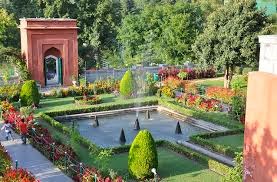
The
garden was constructed around the spring by the Mughal Governor Ali Mardan Khan
in 1632. It was commissioned by the Mughal emperor Shah Jahan for his eldest
son, Dara Sikoh. In the east of Chashm-i-Shahi the Pari Mahal (Fairy
Palace) lies where Dara Sikoh used to learn astrology and where he was later
killed by his brother Aurengzeb. The garden is 108 m long and
38 m wide and is spread over one acre of land. It is the smallest garden
among the three Mughal gardens of Srinagar; the Shalimar garden is
the largest and the Nishat garden is the second largest. All the
three gardens were built at the left bank of the Dal Lake , with Zabarwan
mountains at the backdrop.
Architecture and spring

The garden presents Mughal architecture as used in different Mughal gardens. The artistically build garden has Iranian influence in its art and architecture and the design is based on the Persian gardens. It is built around a fresh water spring, discovered by Rupa Bhawani, which flows through its center in terraces. The topography and the steepness of the land has led the formation of the garden. The main focus of the garden is the spring which flows down in terraces and is divided into three sections: an aqueduct, waterfall, and fountains. A two-storied Kashmiri hut stands at the first terrace which is the origin of the spring. The water then flows down through a water ramp (chadar) into the second terrace. The second terrace serves as a water pool and a large fountain stands at its center. The water again flows down through a water ramp into the third terrace, which is a square five-fountain pool. It is the lowest pool at the entrance of the garden. The visitors are received through a flight of stairs on both sides of the terraces which leads up to the origin of the spring. The English writer and traveler Aldous Huxley wrote about the garden that "the little Chashma Shahi is architecturally the most charming of the gardens near Srinagar". The water of the spring is believed to have some medicinal properties. The former Premier of India, Jawahar Lal Nehru and later prime minister, his daughter Mrs. Indira Gandhi, used to get daily quota of the spring water flown to Delhi

Fourth place that we visited was Indragandhi Gardent of Tulips
The
season stars from March end to middle of April. The full bloom of the colourful
Tulip is short lived. But in July, by the time we went there, there were no Tulip
blooms at all.
Indira
Gandhi Memorial Tulip garden previously named as Model Floriculture
Centre, Sirajbagh, Cheshmashahi, is the largest Tulip garden
of Asia spread over an area of about 12 hectares. It is situated on the
foothills of Zabarwan Hills with an overview of picturesque world
famous Dal Lake.


Nearly 20 lakh Tulips adorn and add color to 20 acres of the Kashmiri Landscape at 5600 feet altitude in Asia’s largest Tulip Garden - the Indira Gandhi Memorial Tulip Garden. A delightful sight - the Flower bed sprawls all over the foothills of the towering Zabarwan Mountain Range, and overlooks the beautiful and the world famous Dal Lake in Srinagar. The Tulip Garden is surrounded on three sides by the Nishat Bagh, Dal Lake and Cheshme shahi Mughal Gardens of Srinagar.


Nearly 20 lakh Tulips adorn and add color to 20 acres of the Kashmiri Landscape at 5600 feet altitude in Asia’s largest Tulip Garden - the Indira Gandhi Memorial Tulip Garden. A delightful sight - the Flower bed sprawls all over the foothills of the towering Zabarwan Mountain Range, and overlooks the beautiful and the world famous Dal Lake in Srinagar. The Tulip Garden is surrounded on three sides by the Nishat Bagh, Dal Lake and Cheshme shahi Mughal Gardens of Srinagar.
Chapter-5,
Mughal Road link
Chapter-7,
Mughal Road link


